
Aww, Rats!
The start of the next adventure
Some time in high school, I first get the idea of rats as an idea for a pet.
I do some googling, read up on it, explore the r/RATS subreddit, and I slowly get convinced it's a good idea. They're smart enough to learn tricks, small enough to not be cramped in a one bedroom apartment, social, playful, and don't live so long as to be a huge time commitment. I really like dogs, and I think of them like a tiny version, in a way.
Naturally, many of my family and some of my friends are apprehensive. I see their face turn as soon as I say the word “rats”. The stigma around rats as gross, infectious pests, mere vermin to catch in a trap, runs pretty deep.
For all of human history, wild rats have followed us around the world to eat our food, either fresh or leftover. They've nibbled at farmers’ crops since farming was invented. They're so opportunistic and human-dependent that they're considered commensal animals. They've thrived in the cracks of every human settlement, from ancient villages to modern metropoli. To this day, they're known as dingy denizens of the city street, the subway tunnel, the sewer system, or the infested kitchen. (This propagates heavily through pop culture too, from Master Splinter to Ratatouille to viral memes like Pizza Rat or the Chicago Rat Hole.) Their bites and droppings can cause disease—and in one particularly memorable case, the fleas on their back carried bacteria that caused the Black Death, killing half of Europe. In the early 1800s, rat-catchers in England would catch and breed them for the bloody game of rat-baiting, where spectators would bet on how fast a terrier could kill them.1 To overturn a reputation like this takes a lot.
But there's been a lot already. Whatever rats weren't used for rat-baiting were brought into labs as test subjects. They became the first animal bred specifically for scientific research, and “lab rats” have been a mainstay ever since. Billions and billions of rats (and mice) have given their lives to research that has saved countless humans from death and suffering from illness.
And, more to the point, some people around the same time period started to see their potential as pets. Rats have been domesticated here and there in centuries past—mixed sources claim this first happening in China and Japan around the 1600s, making it to Europe in the mid-late 1800s—but it was an aristocratic woman named Mary Douglas who really popularized the concept for the Western world. She saw something deeper than disgust when looking into their little eyes: a recognition of their affectionate and intelligent nature, and a deep sense of empathy for her fellow mammal. She spent years evangelizing on behalf of the little guys, and convinced a local Mouse Society to let her and her pet rat into their competitions. Mary's pet rat won Best In Show in 1901, people took notice, and the concept of rats domesticated specifically as pets (dubbed Fancy Rats!) took off.


Nowadays, fancy rats are to wild rats what dogs are to wolves: They're smaller, softer, nicer, come in a variety of colors, and you can find them at the pet store—but it's better to adopt from rescues/sanctuaries.
As a young kid, for a short time, I had two pet gerbils, Snickers and Chocolate. I was young enough that my parents did basically all of the animal care work. The only real memories I have of them now are giving them used paper towel rolls to chew on, a hectic day when they escaped the cage, and the day I learned they died.2
We had a couple of dogs for several years, cocker spaniels named Chloe and Roxie. They were only about half-trained, barked a lot, occasionally soiled the carpet, etc. I was still just a kid, but I helped feed them and clean up, and loved playing and cuddling with them. We had to rehome them when my parents got divorced and couldn't keep the house. I remember crying with my mom while watching their new owner drive away.
As it currently stands, I don't really want children. There are parts of being a dad I'm sure I would enjoy, but the overall cost is pretty prohibitive, and I'm rather scared of screwing it up.
These thoughts and memories are all on my mind as I prepare my apartment for some new arrivals.
Every living situation I've been in since college has felt a little too temporary. I almost did it in 2021, but a job switch hampered things. The next year and a half involved lots of moving and traveling, short stints and long flights. Pets just haven't been in the cards. But these days I feel pretty stable where I'm at, and even if I do move again I reckon it won't be far. So the thought of rats has come back around.
After months of no listings from the local rat rescue, one pops up. A litter of babies. I get to work preparing, and filling out an extensive adoption form.
Picking up a cage and supplies from an ex-rat-owner, I ask her about her experience. Her rats were named Carl and Elmo. She tells me details about her setup, daily and weekly routines, litter training, the things she DIY’d to make parts of things work. The feeling of unpreparedness sets in. The cage parts and supplies are large and heavy. The sense of responsibility even heavier. She hands me panel after panel, box after box, until my sedan is stuffed to the gills.
I can't help but hear Cameron Winter in my head. “Love will call when you've got enough under your arms. Love will make you fit it all in the car.”
I worry about all the ways things could go wrong, the obstacles I may face. What if I fall out of a cleaning habit and their cage stays dirty and they get sick? What if I don't spend as much time with them as I should, or I don't give them enough enriching toys? What if I can't find a sitter when I need one? What if something happens while I'm at work? What if they escape and slip under my front door? What if they get sick and require extensive care and medicine? What if the vet bills rack up way beyond my predictions? What if I accidentally step on one or otherwise seriously hurt them? What if only one is left alive and now it needs a friend?
What if everything goes perfectly well, but I just don't actually enjoy the experience that much? What if I just see them as more mouths to feed?
I meta-worry that the worry will cause me to obsess over every little thing to do with them, sacrificing peace of mind more than necessary, and give into control-freak urges.
I submit the adoption form, but I'm too late; the last two got adopted just yesterday. A wave of disappointment, but also a quiet relief, washes over me.
The rat rescue reaches out a couple weeks later. A woman bought two rats from a pet store, but nobody knew they were a male and female.3 Now she has a huge litter and needs people to take them. If all goes well, I'm taking a few tonight.
I'm still worried. Instead of my usual TV or podcasts I've been watching rat care guides, trying to absorb as much information as I can. I don't have all of the recommended essentials yet, but I think I've got enough to start with: cage with basic decor, food, water, bedding, treats, etc. When the anxiety becomes too much, I go back to r/RATS or a cuteness compilation on YouTube to remember why I'm doing this in the first place.
They say to focus on what you want to see more of. So what if it goes right? What if I get to come home every day to a few cuddly little beasts? What if I play with them? What if I can teach them tricks? What if they like to cuddle, or hang out on my shoulder? What if I still have enough time and balance in my life to work on other things too? What if they bring a smile to my face? What if they're just the cutest little creatures in the whole dang world, yes they are, oh yes they are?


Rats don't live very long, only about 3 years max. I'm setting myself up with a heartbreak time bomb. But pretty much every major life decision comes with one of those, anyway. And it's only proof of the love that was shared and gained along the way.
Here goes nothing…
I met the woman and her rats last night.
The conditions they were kept in were pretty bad: a series of cardboard boxes, way too small, holding 8-10 rats together.4 Some were sick or injured, some had messy fur. I can't fully blame the woman, who didn't ask for this and could not feasibly prepare for a whole extra litter’s worth of space and resources, but it was still sad to see. And it was why I was here, after all.
I picked the three healthiest-looking girls and put them in a new box, trying not to think too much about how this was a somewhat arbitrary decision for me, but life-changing for them. I poked a bunch of holes in the box and taped it up. “They're your problem now!” says the woman's kid, watching this whole thing. Indeed they were.
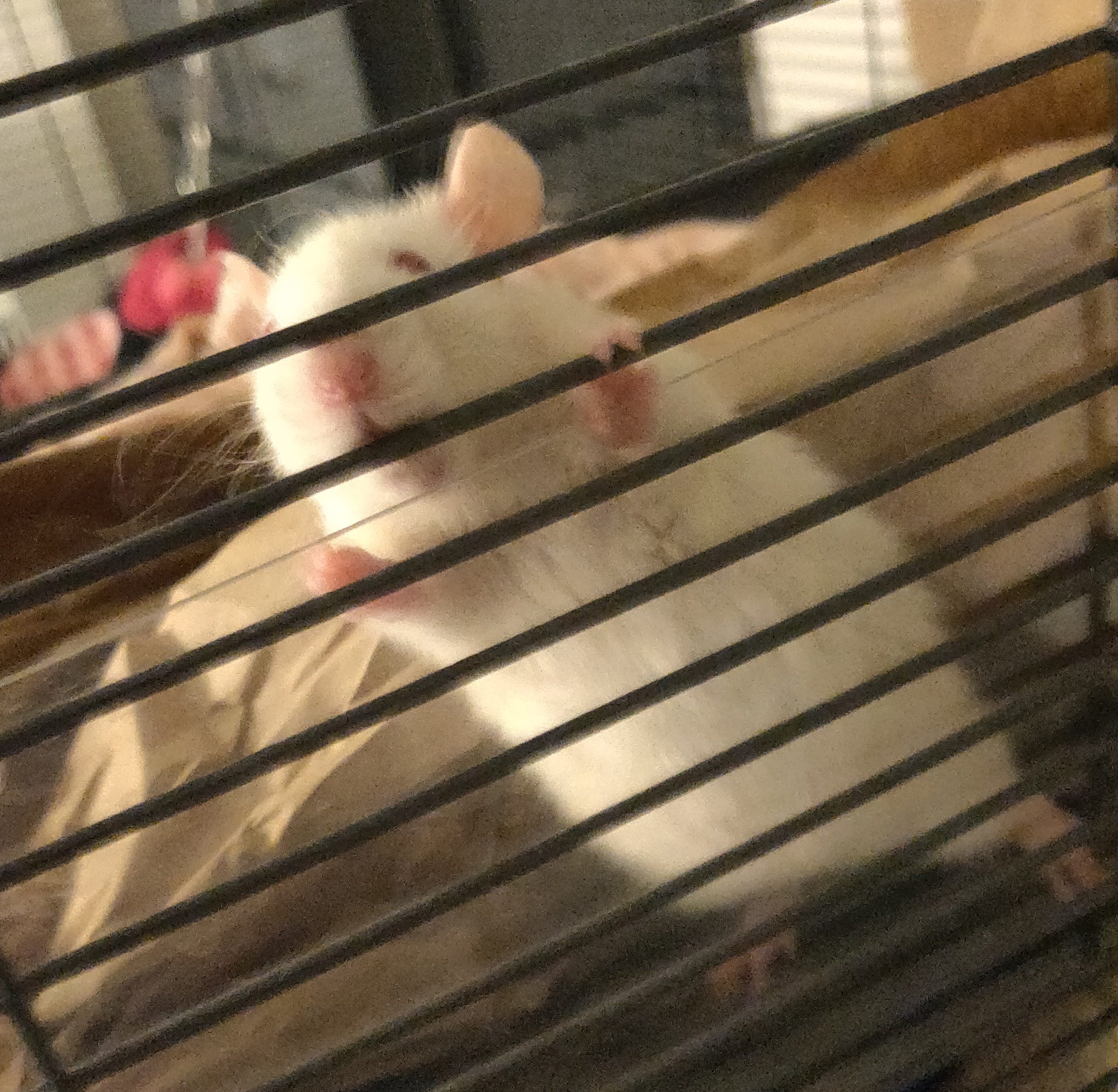
They were probably pretty stressed during the drive home; I could hear them scratching at the sides of the box. But once I arrived and opened it up, three pairs of curious little eyes looked back at me. I put them in the cage and they spent hours roaming, climbing and exploring the space. They seemed excited, playing and wrestling with each other. I'm full of nervous energy, but I can't help but crack a smile.
Welcome home, little ones. ❤️
One of the renowned rat-catchers at the time was named Jack Black, interestingly.
My parents attest they escaped again and were never found, but I remember seeing their bodies in the cage. I don't know which of us is right; memory is very fickle.
I'm surprised at the rate this happens: male rats are easy to tell apart by their enormous balls.
It’s possible they had better permanent accommodations, but this is how they were presented to me, and the boxes seemed rather lived-in.
i had pet rats in middle school that would ride around on my shoulder and take naps in my shirt pocket while i did my homework. my neighbor (who also had one) and i used to build mazes for them to play in. they are just the best! i’m super excited for you. 🥹
Ahhh congratulations!!! I can't wait to meet them. It's been a long time coming, and I'm sure y'all will be best friends
It tickles me that Mary Douglas, the first person to advocate for pet rats, was gender non-conforming. The connection between pet rats and GNC people still runs deep!